Building in Public Series - Update from July 4th, 2025
Status update since Monday: Holy shit, we're making progress! 🚀
What happened since my "17 Apps" post
Friday: First post about my failed app experiments
Tuesday-Wednesday: Refined concept and planned landing page
Thursday: Built and designed landing page
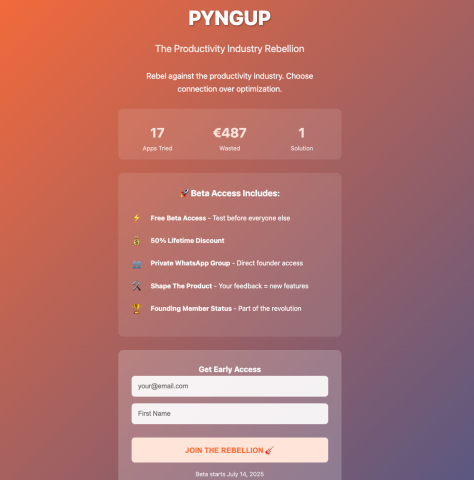
Today: pyngup.com is live! 🎸
Implementing my concept confirms: It's more than an app
The concept I've been developing for months is finally taking shape: PYNGUP is a completely new productivity philosophy.
Not just "another to-do app", but:
- ✅ New methodology: Social commitments instead of lonely to-dos
- ✅ Community approach: Peer-to-peer instead of guru dependency
- ✅ Psychology-based: Working with evolution, not against it
- ✅ Anti-perfectionism: Humanly productive, not robotically optimized
The app is just the tool. The philosophy is the revolution.
Landing Page Learnings
pyngup.com has been live since yesterday and I'm already learning a lot:
What works:
- "17 Apps / €487" hook resonates strongly
- "Never Mind the Bollocks, Here's PYNGUP" makes people smile
- The rebellious vibe differentiates us from standard productivity apps
What I still need to fix:
- Double opt-in process (technical problem)
- Mobile optimization could be better
- More concrete examples of how PYNGs work
Beta strategy taking shape
Plan for July 14th Beta Launch:
- Personally onboard every beta tester (max. 50 people)
- Private WhatsApp group for direct feedback
- Co-creation: Users help with development
- Document the entire process (Building in Public!)
Why so small? I want real connections, not vanity metrics. Rather 50 enthusiastic early adopters than 500 passive users.
The technical side
What's already running:
- Responsive landing page with rebellion aesthetic ✅
- Domain, hosting, analytics setup ✅
- Email list foundation (except for opt-in bug) ✅
What's coming next:
- MVP app development: Testing Android platform
- Three-bucket system (INBOX/TODAY/TOMORROW) as foundation
- PYNG-sharing features for social commits
- Community features for peer support
Tech stack will be: Vue.js + Supabase (fast, flexible, affordable)
Incorporating community feedback
Interesting reactions so far:
- "Finally someone who's honest about productivity fails"
- "Social commits sound interesting, but how does it work concretely?"
- "Curious if this is really different from other apps"
This shows me: People want authenticity + concrete examples.
What I'm doing this week
Today (Friday):
- Fix double opt-in bug
- Show landing page to first beta testers
Weekend:
- App: PYNG sharing function
- Write first user stories for PYNG system
- Prepare social media content for next week
Next week:
- Continue app development
- Blog more about the methodology (not just the app)
- Build community for beta testing
The biggest challenge: Not overcomplicating
As a developer, I tend to plan too many features. But PYNGUP should be radically simple:
❌ Not: 50 features like Notion
✅ Instead: 3 core functions that work perfectly
❌ Not: Complicated gamification
✅ Instead: Simple social motivation
The art lies in reducing to the essential.
Building in Public Reflection
What I'm learning from building publicly:
- Authenticity works better than perfection
- People want real stories, not marketing speak
- Community emerges through vulnerability, not through success
- Documenting forces me to think clearer
Next post: Probably about app design and first user tests.
Call-to-Action
If you're also fed up with lonely productivity optimization:
- Check the landing page: pyngup.com
- Sign up for beta (once the bug is fixed 😅)
- Share your own productivity fails in the comments
If you know other Building-in-Public founders: Connect me! I love learning from others who report honestly about their journey.
The rebellion continues!
P.S.: Who else follows Building-in-Public journeys? Please recommend other authentic founders I should follow!
Comments